Who Was Gaurav Tiwari? Bhay, the Indian Paranormal Society, and a Death That Still Raises Questions
December 27, 2025
The Ghost Hunter Who Became the Mystery
India has heard countless ghost stories — but very few involve the man who spent his life trying to explain them. The new series Bhay has reignited interest in Gaurav Tiwari, the co-founder of the Indian Paranormal Society (IPS), whose life ended in controversy and unanswered questions.

This is not just the story of a paranormal investigator.
It’s the story of a man who walked a dangerous line between belief and logic — and didn’t make it back untouched.
Who Was Gaurav Tiwari, Really?
Gaurav Tiwari wasn’t a tantrik, godman, or horror entertainer. Through the Indian Paranormal Society, he positioned himself as a paranormal researcher, insisting that alleged hauntings should be investigated using scientific tools, psychology, and controlled observation — not superstition.

IPS investigations relied on:
- EMF detectors and thermal sensors
- Audio and environmental analysis
- Psychological profiling of witnesses
This refusal to blindly accept or dismiss paranormal claims made him deeply polarizing. Believers accused him of disrespecting faith. Skeptics accused him of legitimizing superstition. He stood alone in the middle.
The Real Cases That Made Him Famous — and Uncomfortable
Unlike dramatized horror shows, Tiwari investigated real locations that already carried fear in public imagination:
- Mukesh Mills (Mumbai): overnight investigations and reports of unexplained audio patterns
- Sanjay Van (Delhi): shadow sightings and environmental anomalies
- GP Block (Meerut): mass hallucination theories that angered locals
- Private possession cases: where he openly debunked godmen, earning hostility
His work threatened belief-based businesses — and that came with consequences.
The Controversial Death That Changed Everything
In 2016, Gaurav Tiwari was found dead in his Mumbai home. Authorities officially ruled the case a suicide.

But the public reaction told a different story.
Questions followed immediately:
- No publicly released suicide note
- Conflicting accounts about the locked room
- No known history of severe depression
- Active investigations and future plans at the time
Friends later claimed he spoke about fear, not hopelessness. The case closed officially — but never emotionally.
Murder, Pressure, or Psychological Collapse?
Three theories continue to divide opinion:
- Psychological Breakdown-Years of ridicule, isolation, and constant exposure to disturbing environments took a toll.
- External Pressure-By challenging occult practitioners and superstition-driven systems, Tiwari may have angered powerful figures.
- Curiosity That Went Too Far-Paranormal believers insist he uncovered something dangerous — a claim science rejects but public imagination won’t release.
None of these theories have been proven. That uncertainty keeps his story alive.
How Bhay Brings the Story Back — Carefully
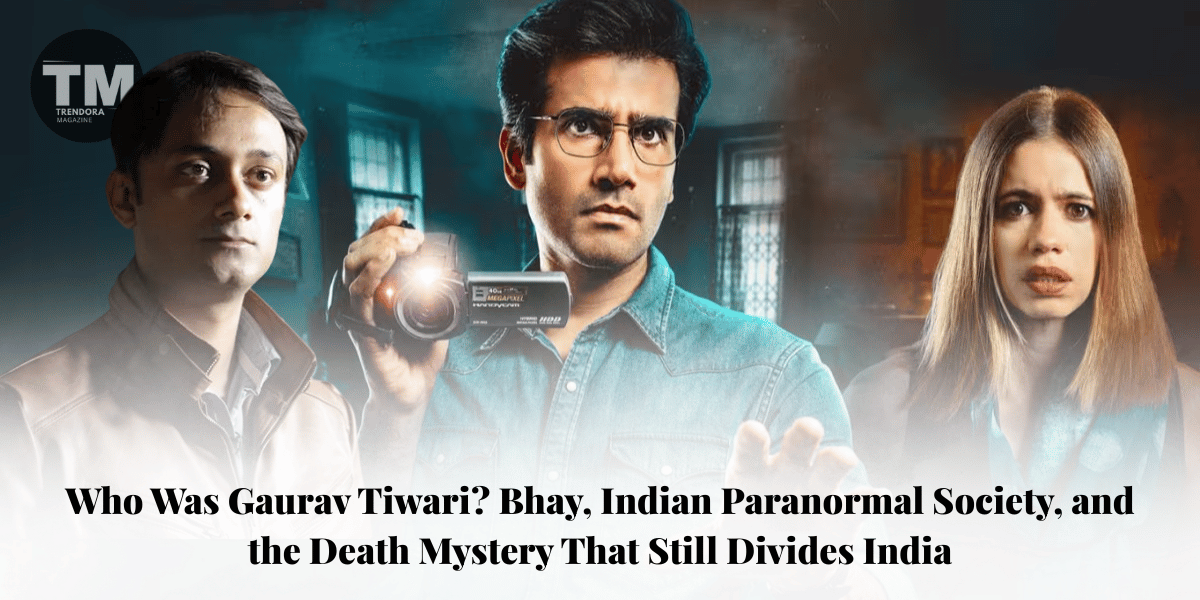
Bhay avoids jump-scare horror. Instead, it focuses on obsession, emotional erosion, and isolation — themes closely tied to Tiwari’s real-life journey.
The character inspired by him is portrayed as a man slowly consumed by his pursuit of answers, not frightened by ghosts but exhausted by the weight of the unknown.
Karan Tacker and the Weight of Playing Gaurav Tiwari
The role inspired by Tiwari is portrayed by Karan Tacker, who has spoken about the emotional heaviness of the shoot.
According to cast discussions:
- Night shoots felt psychologically intense
- Certain locations carried an unsettling atmosphere
- Crew members experienced anxiety and exhaustion
No supernatural claims were made — but many admitted the story lingered beyond the set.
Why This Story Still Haunts India
Gaurav Tiwari didn’t prove ghosts exist.
He proved something more uncomfortable: questioning belief in India comes at a cost.

Bhay doesn’t solve his death. It reflects the same silence that followed it — leaving viewers with questions instead of closure.
A Legacy Without Resolution
Some stories end with facts.
Some end with faith.
Gaurav Tiwari’s story ends in between.
And that unresolved space — between fear and reason — is exactly why his name, his work, and Bhay continue to haunt the conversation.
Author

Share this:

Discover more from Trendora Magazine
Subscribe to get the latest posts sent to your email.